

Baby Names 2025
A fun post for the curious
It’s time for the yearly baby names post. This is the third year I’ve done a baby names post, and here are links to the 2024 and 2023 editions. As a bonus, last year I did an extra baby names post with Hannah Emmery, which has some cool animations. The data comes from the Social Security Administration, which has historical and state data on their Beyond the Top 1000 page.
The top 100 baby names for 2025 are in the table below, along with the 2024 rank and the change in rank from last year. All columns are sortable by clicking on the column names. The top four male names are unchanged from last year. In the top 20, the big male riser was Elias, moving up 12 spots to number 13, but that’s nothing compared to Ailany, which rose 87 spots on the female list. Enjoy exploring the top 100 names.
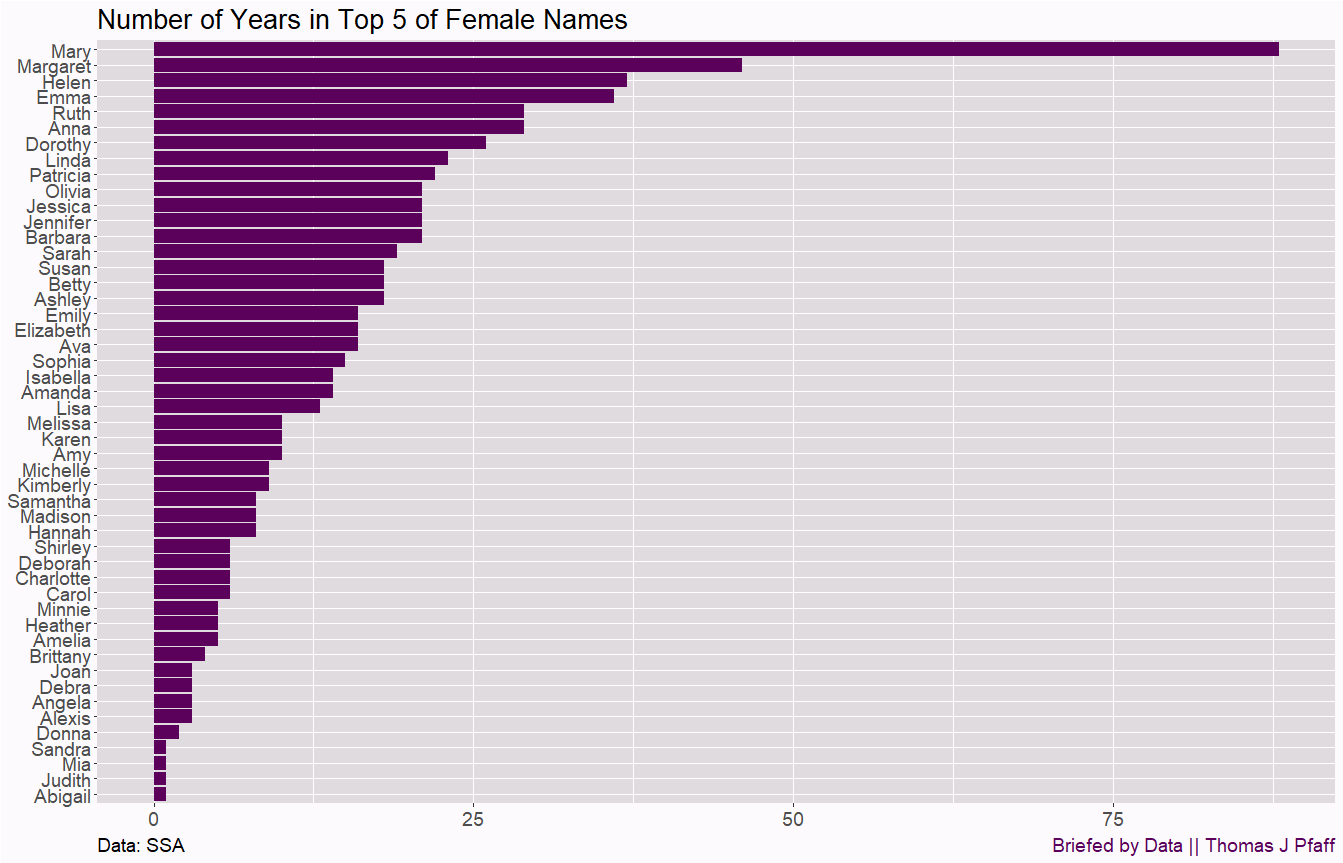
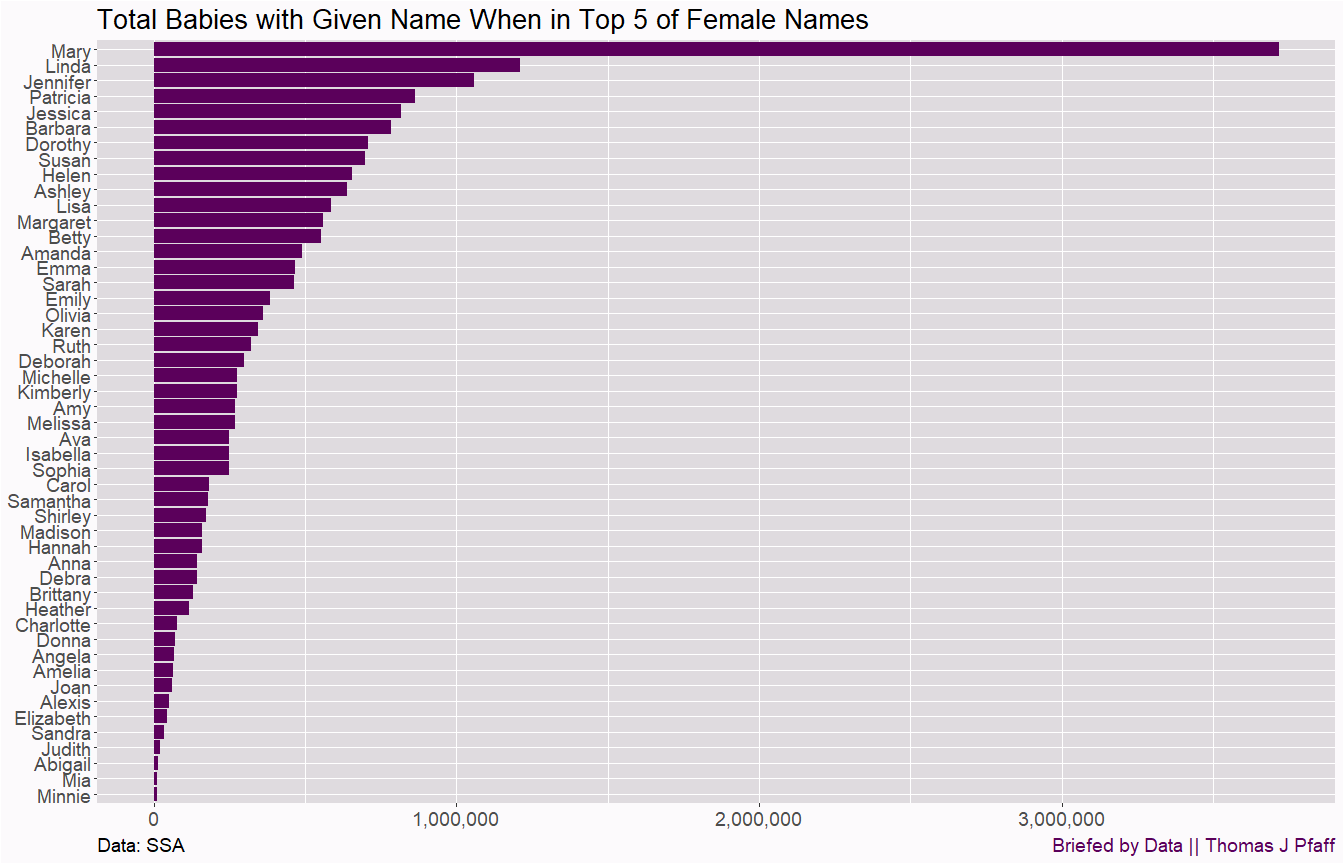
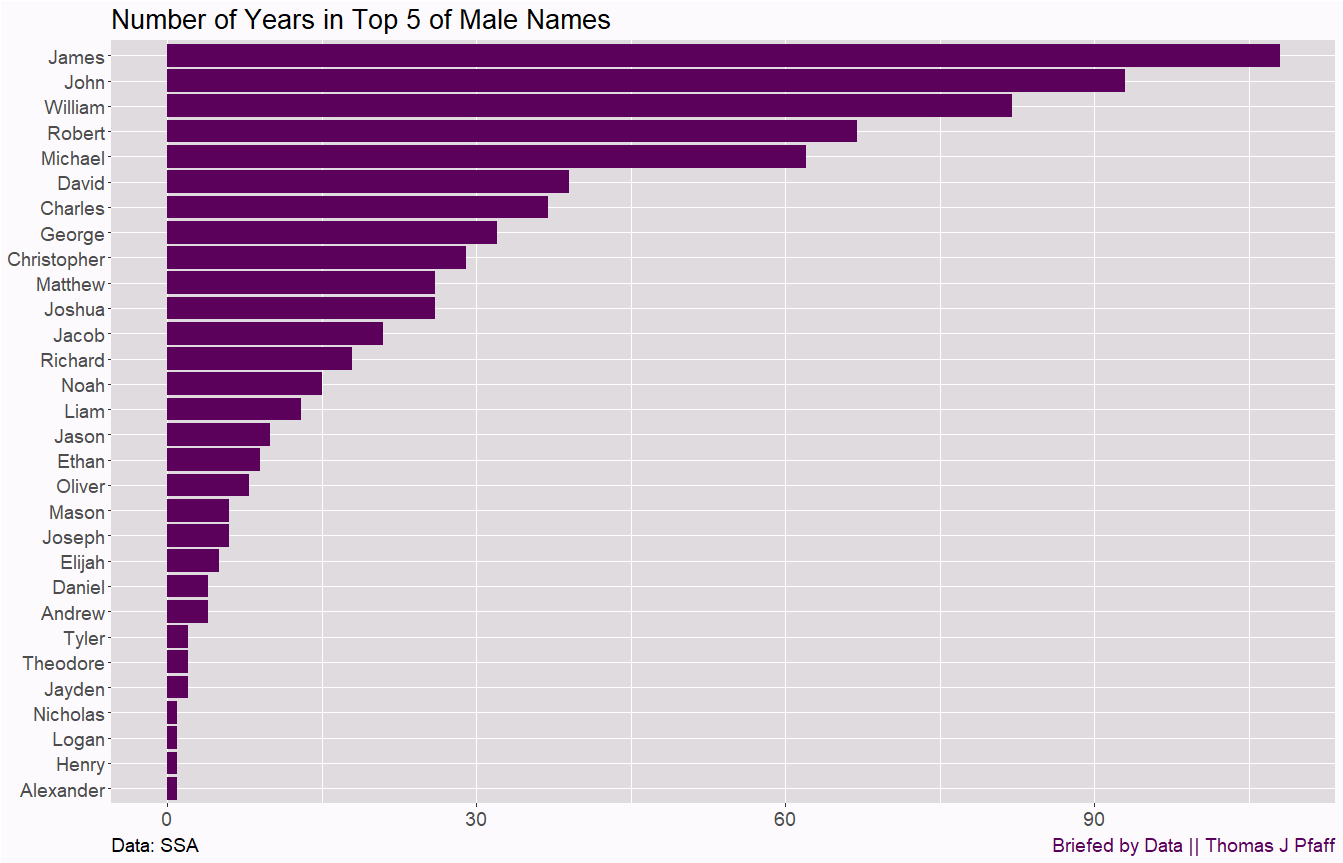
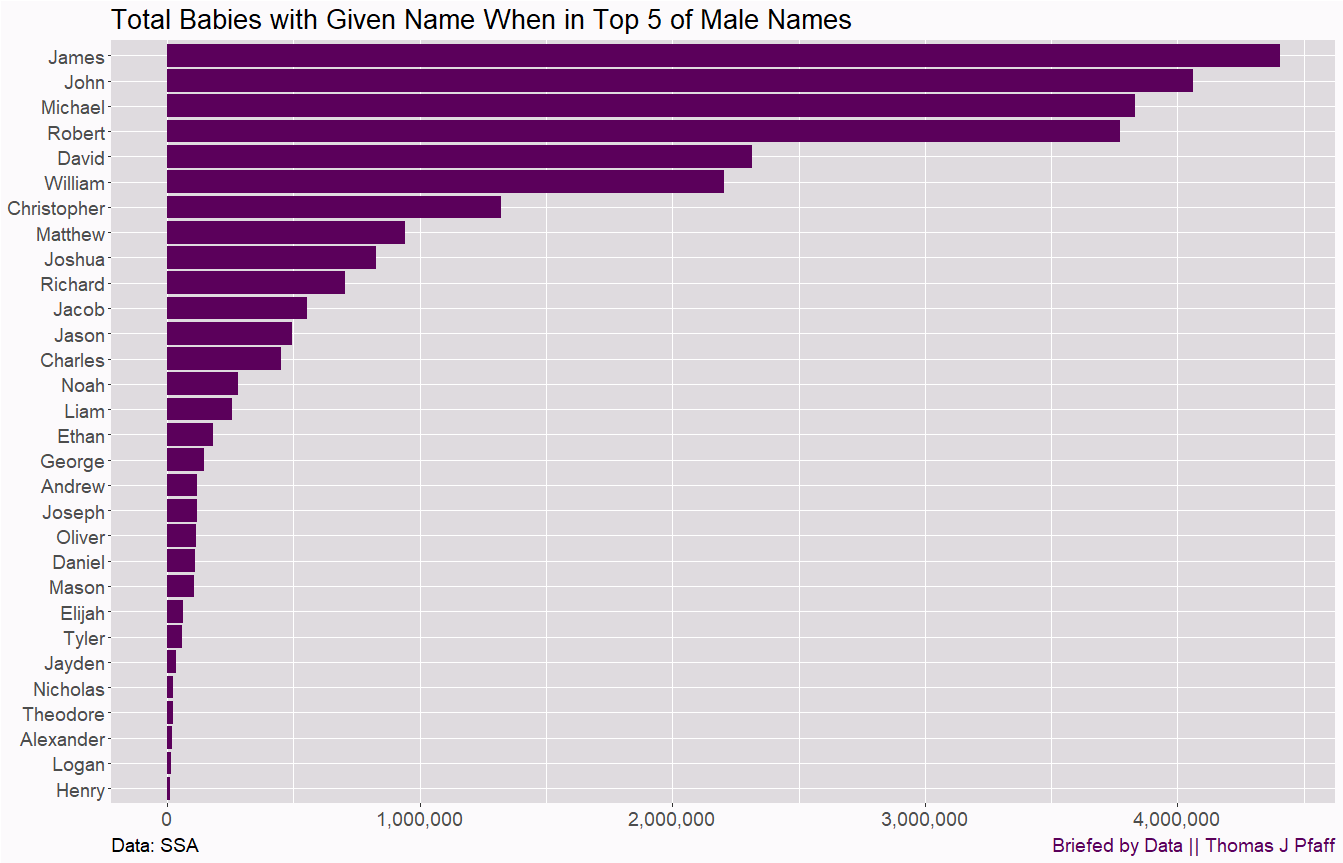
In the past two years, I looked at distributions of names and the first letter of names, so I thought I’d do something different this year. I looked at both female and male names that made it to the top 5, how much time they spent in the top 5, and how many babies were given the name while it was in the top 5.
For female names, Mary had spent almost 90 years in the top 5 (Figure 1), which is well over 40 years more than the second-place name, Margaret. Emma, 4th on the list, is still adding years in the top 5 with a third-place showing on this year’s list.
With almost 90 years in the top 5, Mary was given to 3.75 million babies, Figure 2. Note this count only when in the top 5; it was still given when not in the top 5, and so the total number of babies named Mary is much higher. Mary dominates even the second-place name of Linda, with roughly 1.25 million babies given the name. Notice how Emma is 14th on this list due to decreased use of names in the top 5.
For males, the name that has spent the most time in the top 5 is James (Figure 3), with over 105 years in that position, surpassing Mary. Nevertheless James doesn’t dominate the list the way Mary does, as John is not that far behind. Mary is in a class all her own.
On the other hand, James was handed out to almost 4.5 million boys (Figure 4), and the four most popular boys in the top 5 were given to more boys than Mary was to girls. The distributions of female and male names are distinctly different, and the post with Hannah has some explanations.
I hope you enjoyed the yearly baby names post, and if you have baby name questions, data-related, you’d like answered, let me know and I might do a follow-up this year.
Please share and like
Sharing and liking posts attracts new readers and boosts algorithm performance. I appreciate everything you do to support Briefed by Data.
Comments
Please tell me if you believe I expressed something incorrectly or misinterpreted the data. I'd rather know the truth and understand the world than be correct. I welcome comments and disagreement. I encourage you to share article ideas, feedback, or any other thoughts at briefedbydata@substack.com.
Bio
I am a tenured mathematics professor at Ithaca College (PhD in Math: Stochastic Processes, MS in Applied Statistics, MS in Math, BS in Math, BS in Exercise Science), and I consider myself an accidental academic (opinions are my own). I'm a gardener, drummer, rower, runner, inline skater, 46er, and R user. I’ve written the textbooks “R for College Mathematics and Statistics” and “Applied Calculus with R.” I welcome any collaborations, and I’m open to job offers (a full vita is available on my faculty page).