

QTRS December 4, 2025
Graphs, commentary, and interesting content for the curious
As I see it…
Over the past couple of weeks I read three articles, all by outlets that academia would suggest I shouldn’t read, that really made me stop and wonder how much I’m missing or actually how much more I don’t know than I already think I don’t know. Very brief recaps of all three.
The first up is The Unwelcome Truth about Rape—for their research showing that rape is generally motivated by sexual desire, Randy Thornhill and Craig Palmer were subjected to death threats and hounded in their personal and professional lives. And yet, they were right. (11/27/2025)
In their work, Thornhill and Palmer excuse nothing and absolve no one. They simply remind people that sexual violence has something to do with biology and that ignoring that fact means—at best—misunderstanding the nature of rape and, at worst, harming victims. In the face of such heresy, the outrage machine went into overdrive. There were defamatory articles, bad-faith readings, insults, and even threats from which the researchers needed police protection. At the end of it all, both their lives had been irreparably damaged.
Thornhill and Palmer's crime was providing evidence that rape is not solely about power; it also has a sexual component. This goes against the current orthodoxy, and for their efforts, “their lives had been irreparably damaged.” Read the article for details. Even if they are completely wrong, the response to their work is completely out of line, and if they are right, the response is trying to bury unwanted truth.
Teen Violence—When Ideology Trumps Data (3 - Bias Against Men and Boys in Psychological Research) 2010 (11/29/2025) was reposted and was new to me. It is a wonderful example of how well-done research gets filtered along the way to reaching the public.
The original news article I had read had mentioned that the research had found that 25% of girls said they had been physically abused by their boyfriends. What the news article omitted saying was that the same research had also found that 18% of boys had said that they had been physically abused by their girlfriends. This meant that this research found that almost half of the victims of teen relationship violence were boys! Somehow this important fact had been omitted from the news report.
It turned out to be a two-step process. The original research was excellent, but in their summary they downplayed the result about boys, and then the results were ignored by the media that likely never read beyond the summary.
Male violence against women is generally worse due to size and strength differences, but that doesn’t excuse ignoring the reverse. A Google search for domestic violence yielded the following result:
Research also indicates that females perpetrate IPV. Authors of an article on prior studies of IPV in heterosexual relationships found 28.3% of females and 21.6% of males reported perpetrating physical violence in an intimate partnership.
If you asked people about relationship violence, most would say that it is all about the males.
Last up is “Don’t Be a Feminist” (11/25/2025), which is a transcript of a speech given by Bryan Caplan at the University of Chicago.
But you may have heard of confirmation bias—only looking for evidence that supports your view. If you want to actually understand the world, you go, “Okay, that’s the evidence in support of my view—what’s the evidence against my view?” Here are some facts that are also demonstrably true: Men are overrepresented at the bottom levels of society. They do most of the nasty, dangerous work. They’re much more likely to be homeless or imprisoned, and much more likely to kill themselves. Men spend much more time on the job than women. The law heavily favors women in child custody and child support disputes. Men are more likely to be victims of violent crime in general. Men are much more likely to die in combat—and actually, during serious military conflicts, men face military slavery: the draft. Women view men as success objects. This is another thing—it’s true.
As I see it, my point here is not to say what is true here but to point out that there are arguments and viewpoints that don’t make it to the media or a college classroom. I don't know how to increase viewpoint diversity, but it's clear that the educated class has acceptable views, and deviating from them based on your job is risky. Society isn’t being improved by this setup.
Public service announcement
For those of you in K-12 or who know someone who is Apply Now! Summer 2026 Professional Development at the Library of Congress
Join us onsite at the Library of Congress in Washington, D.C. for a free three-day professional development workshop, where you’ll learn and practice strategies for using primary sources with K-12 students.
I follow LOC posts, and they do some excellent stuff. I bet this would be a wonderful experience.
Polls on higher education
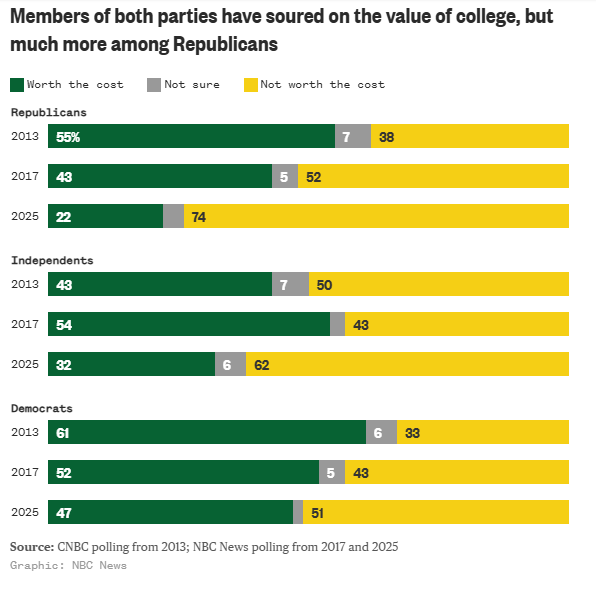
The first result is from an NBC News poll reported in Poll: In a dramatic shift, Americans no longer see four-year college degrees as worth the cost (11/28/2025)
What is really amazing here is the response from higher ed to all of the recent polling is a lot of nothing. Even Democrats are losing faith in the value of the degree, and if they want to argue, "Who cares about Republicans and Independents?" well, ok, but that’s a lot of potential students you are going to lose.
The College Fix reports (12/2/2025) on a separate poll with similar findings.
The Overton Insights poll asked respondents if they thought a bachelor’s degree today was worth the cost.
Only 14 percent of poll respondents gave an unequivocal yes, while 43 percent said yes but only for specific degrees (such as doctors, lawyers, etc.). Another 38 percent said no.
However, 67 percent of respondents still hold the belief that a college degree is important for someone to succeed in their career today. Only 30 percent said it was not important.
The CEO of Overton Insights provided further analysis of the results in emailed comments to The College Fix.
Connor Boyack said the survey “reflects widespread disillusionment with the higher education industry as a whole—high costs, low quality, and uncertain ROI (return on investment).”
Public polling reflects the industry's numerous issues, leading you to expect significant changes. But so far it isn’t happening. In my limited sphere, I frequently encounter discussions suggesting that the general public fails to recognize the true value. Well, smart people, educated people, maybe you need to explain it better, or maybe you are missing something (read As I see it above).
Evidence for banning phones
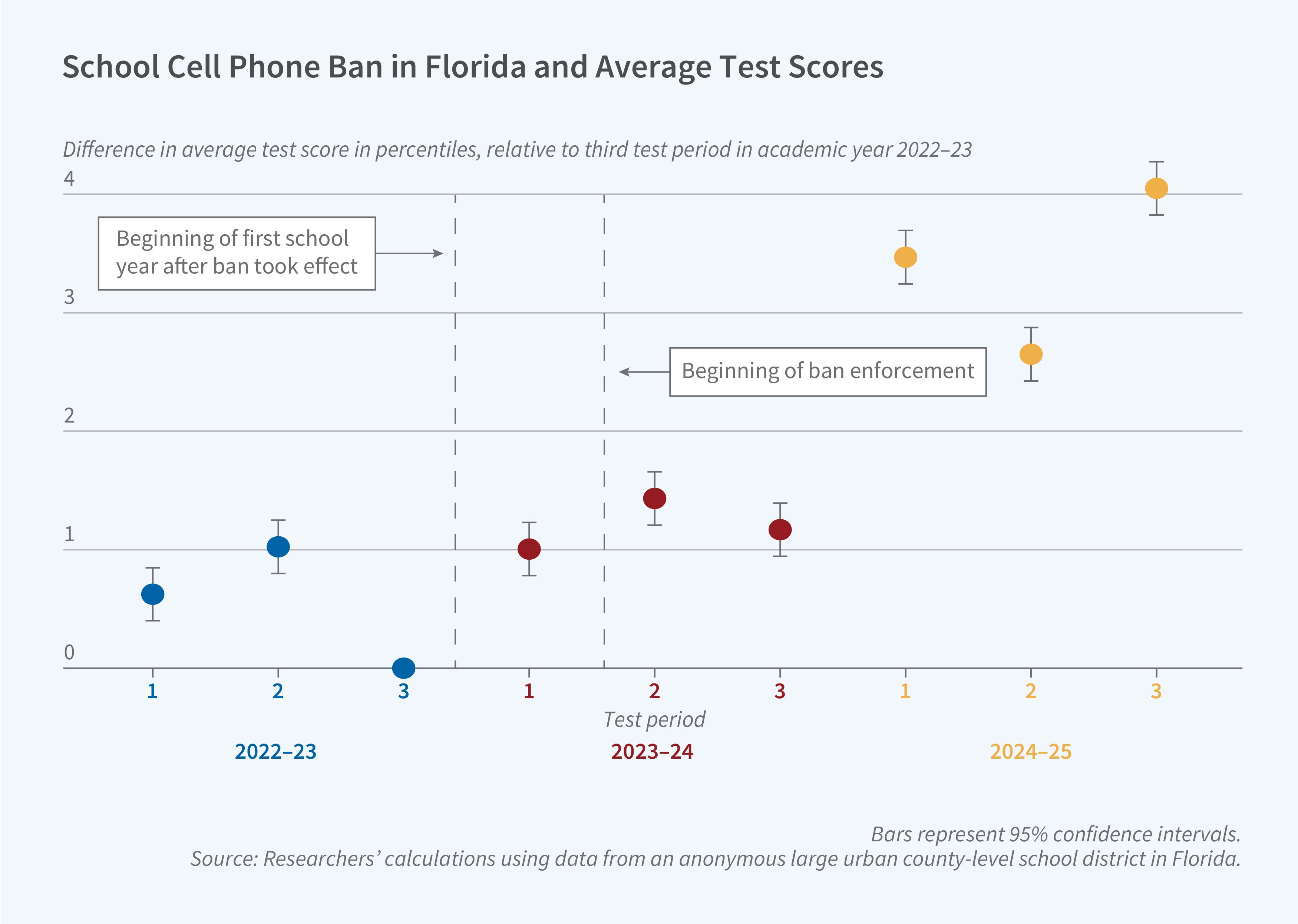
I keep saying that COVID isn’t the real issue with declines in test scores, and the NBER working paper The Impact of Cell Phone Bans in Schools on Student Outcomes: Evidence from Florida (12/1/2025) has some evidence.
Three graphs comparing countries
The World Population Review Newsletter had several intriguing posts over the last two weeks. Highlights.
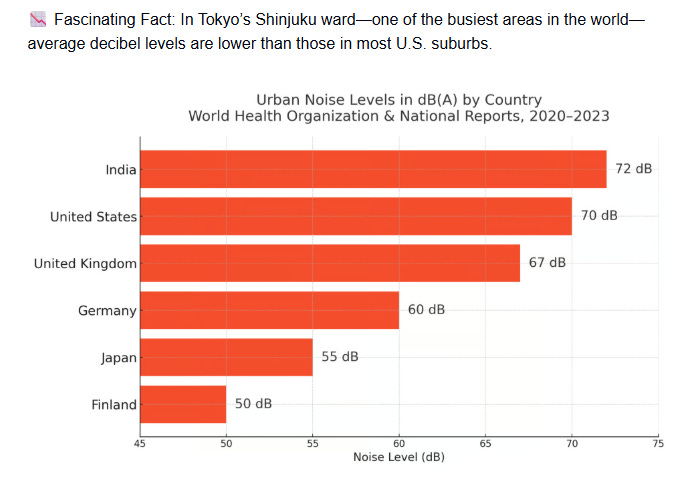
The U.S. is a loud place (12/1/2025).
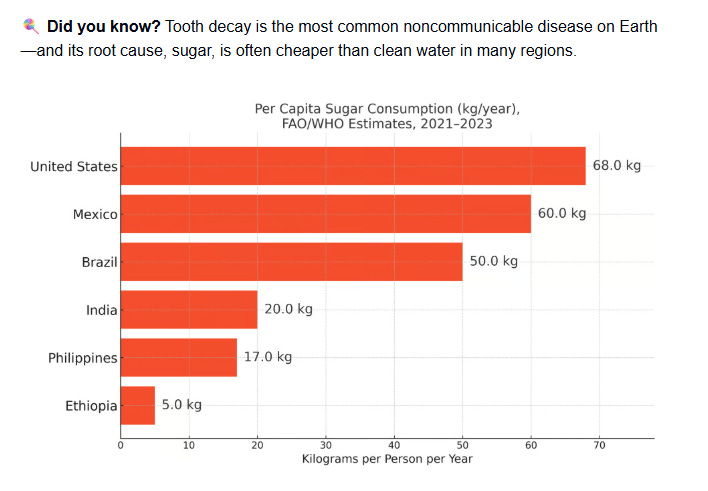
The U.S. is tops in sugar consumption (11/28/2025)
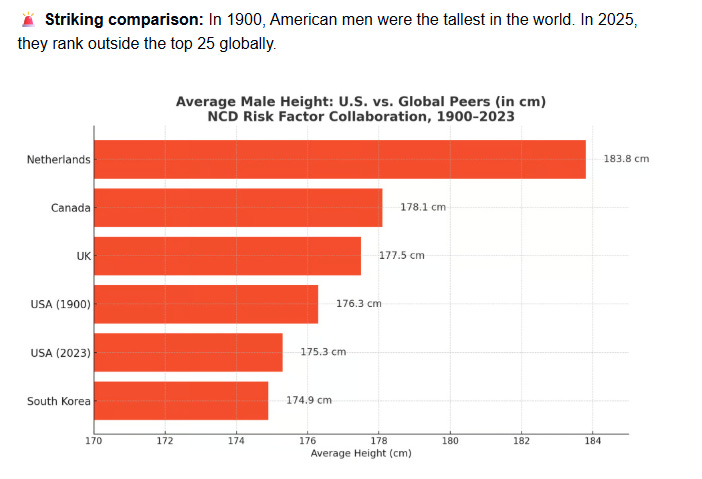
U.S. Male height is shrinking (12/4/2025)
By a generator?
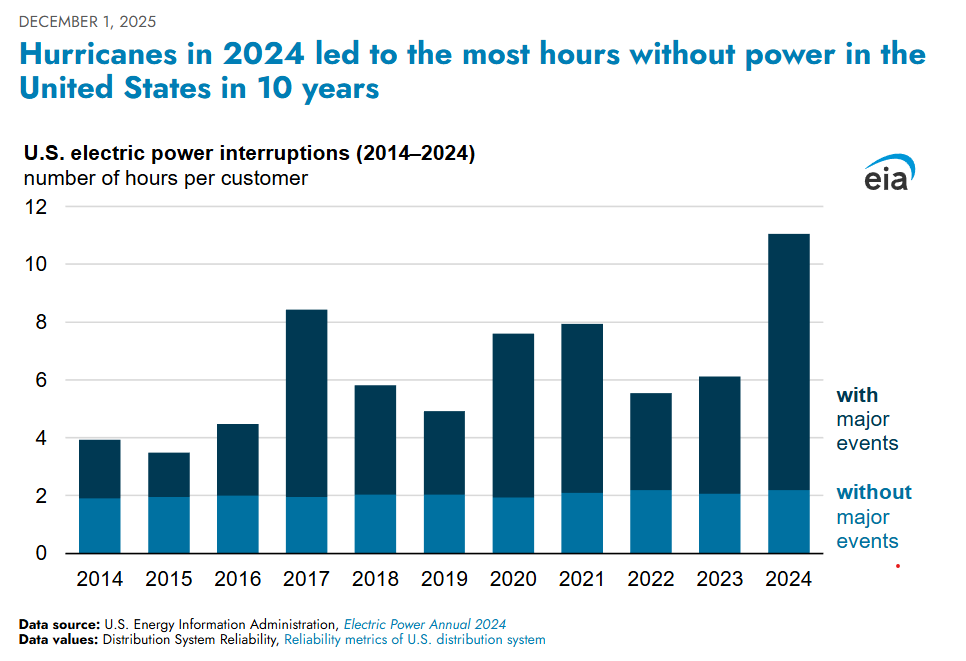
Here is your EIA graph of the week.
Data center update
Serverfarm targets 135-acre data center campus in Arkansas—Company planning six-building campus in the Natural State (11/27/2025)
Data center proposed for 500-acre site in Page, Arizona. But some residents already want to turn the Page on the 1GW scheme. (11/24/2025)
Amazon to build $3bn data center campus in Vicksburg, Mississippi. Construction to begin in 2026. (11/21/2025)
The spinning CD
I’ve always been a fan of horn sections in rock music.
Please share and like
Sharing and liking posts attracts new readers and boosts algorithm performance. I appreciate everything you do to support Briefed by Data.
Comments
Please let me know if you think I expressed something incorrectly or misinterpreted the data. I would rather know the truth and understand the world than simply be correct. I welcome comments and disagreement. I encourage you to share article ideas, feedback, or any other thoughts at briefedbydata@substack.com.
Bio
I am a tenured mathematics professor at Ithaca College, holding a PhD in math (stochastic processes), an MS in applied statistics, an MS in math, a BS in math, and a BS in exercise science. I consider myself an accidental academic (opinions are my own). I am a gardener, drummer, rower, runner, inline skater, 46er, and R user. I’ve written the textbooks “R for College Mathematics and Statistics” and “Applied Calculus with R.” I welcome any collaborations, and I’m open to job offers (a full vita is available on my faculty page).