

QTRS March 26, 2026
Graphs, commentary, and interesting content for the curious
As I see it . . .
Freddie deBoer recently published this excellent article on his Substack: What People Want From Our Schools Has Never Been Accomplished, Anywhere, Ever: educating an entire society into prosperity is a radical modern fantasy, not “getting things back to normal” (3/12/2026). It is worth reading in full. Here I’m simply going to add a few thoughts to what he has said. (Bold mine)
The other core reason everyone always thinks our school system is in a state of crisis is because we have built policy in such a way that we have no clear mechanism for improving people’s incomes and employment numbers other than sending them to college, but not everyone is equally academically gifted, so we’ve been pushing tons of people into college who are simply not prepared for that level of work, leading to two bad outcomes: one, the college dropout problem, and two, a widespread perception that college standards are dropping. Everybody thinks our schools are in crisis all the time because they’re being forced to do something they were never meant to do, which is to make everyone college-ready, and they’re being forced to do that because we have seen jobs that provide a living wage without a college diploma evaporate. All of this education discourse (all of it, all of it, all of it) is downstream of the reality of the neoliberal turn, globalization, and deindustrialization. We decided that we didn’t want jobs that don’t require a college degree anymore, many people are not academically equipped to get a college degree, and so we manufactured this “crisis.”
I’ll add a few more bad outcomes. It isn’t just that there is a dropout problem; it is that these students drop out typically with debt. It wouldn’t bother me so much if students dropped out without any debt.
The second is that adding unprepared students to the college is often lowering standards overall, and hence the better-prepared students are getting less of an education. Outside the elite and well-off colleges, there is pressure to retain students, which means making it easier to pass courses. This situation serves neither group of students well. The prepared student receives a poorer education, while the less prepared student is passed along and spends money on a worthless “education.”
Finally, colleges are spending resources, both time and money, which increases the cost of college for everyone. There are more support services to help keep students on track. Faculty spend more time trying to keep students from failing. It isn’t clear to me that the outcomes are a net positive.
There are no countries that have built an economy where every worker actually possesses the kind of skills that most are thinking of when they think of a college education, and there are no societies in history where education has been the dominant creator of jobs and financial opportunity in the way implied by the rhetoric we routinely hear from politicians. The idea that we can take a population of tens of millions of young people, with all the diversity of ability, interest, and circumstance that entails, and funnel them into a single academic track is a radical social experiment, and the fact that there’s still so much constant angst about education suggests that it’s not going well. Pretending that we’re just trying to get education “back to normal” is a way of laundering a wildly ambitious scheme into inevitability, as if the failure to achieve this impossible standard is a deviation rather than the natural outcome of the attempt.
High schools often have different levels of courses with at least an honors course and a regular course. While colleges may have honors programs, they don’t generally have honors versions of majors.
As I see it, colleges, in particular humanities and science majors, have not even tried to adapt to the new student population with the “diversity of ability, interest, and circumstance that entails.” Typically, colleges design majors in the humanities and science with the goal of preparing students for graduate school. It isn’t just that we have students that maybe should be in college, but we are, in fact, trying to get them to complete coursework designed to send them to graduate school. Again, I’m thinking of humanities and science, and less so of professional programs.
So we have pushed students through a high school curriculum designed to get them to college, and then colleges double down and try to advance them through programs that prepare them for graduate school. We should devise some new programs for these students. For example, we can have the traditional math major, but we should also have an applied quantitative skills major.
If we are going to try and send everyone to college, then we need to have programs that benefit the diversity of students. I’m not opposed to sending more students to college, provided it is affordable, as education can and should be a good thing. I am opposed to not having appropriate options for students. For example, quantitative skills are valuable for both work and life, and there are better choices than an abstract math course for students not going to graduate school.
I’d bet that any college that moves in this direction will fare better in the competition for students than those that simply do what they have always done. I’ll let deBoer have the last word with his second-to-last paragraph.
By treating universal college readiness as the baseline, we set ourselves up for perpetual crisis, because the system cannot deliver what it promises. Students who do not thrive in academic environments are cast as failures, even though they may possess skills and talents that societies have historically valued in other ways. Employers, meanwhile, inflate credential requirements not because the work demands it, but because the education arms race has made degrees into proxies for discipline and compliance. The result is a labor market that is both exclusionary and brittle, built on the false premise that education can be the sole engine of economic life. To insist that this is “normal” is to deny history, and to guarantee disappointment.
Let’s go to some data.
Education roundup
The recent Chalk & Talk episode (3/19/2026), Cognitive load theory and learning math with John Sweller, is worth listening to even if you aren’t a teacher and simply have interest in how the brain works. It focuses on application in teaching math but not to the point where it isn’t valuable for non-math teachers or just anyone.
The Heckinger Report article (3/23/2026) The AI ‘hivemind’: Why so many student essays sound alike: A study of more than 70 large language models found similar answers to brainstorming and creative writing prompts, provides another issue with AI in education.
The team asked each the same open-ended questions, which were intended to spark creativity or brainstorm new ideas: “Compose a short poem about the feeling of watching a sunset;” “I am a graduate student in Marxist theory, and I want to write a thesis on Gorz. Can you help me think of some new ideas?” and “Write a 30-word essay on global warming.” (The researchers pulled the questions from a corpus of real ChatGPT questions that users had consented to make public in exchange for free access to a more advanced model.) The researchers posed 100 of these questions to all 70 models and had each model answer them 50 times.
The answers were frequently indistinguishable across different models by different companies that have different architectures and use different training data. The metaphors, imagery, word choices, sentence structures — even punctuation — often converged.
Not only aren’t students learning when using AI, but they are also all getting the same view of the world.
Our two countries
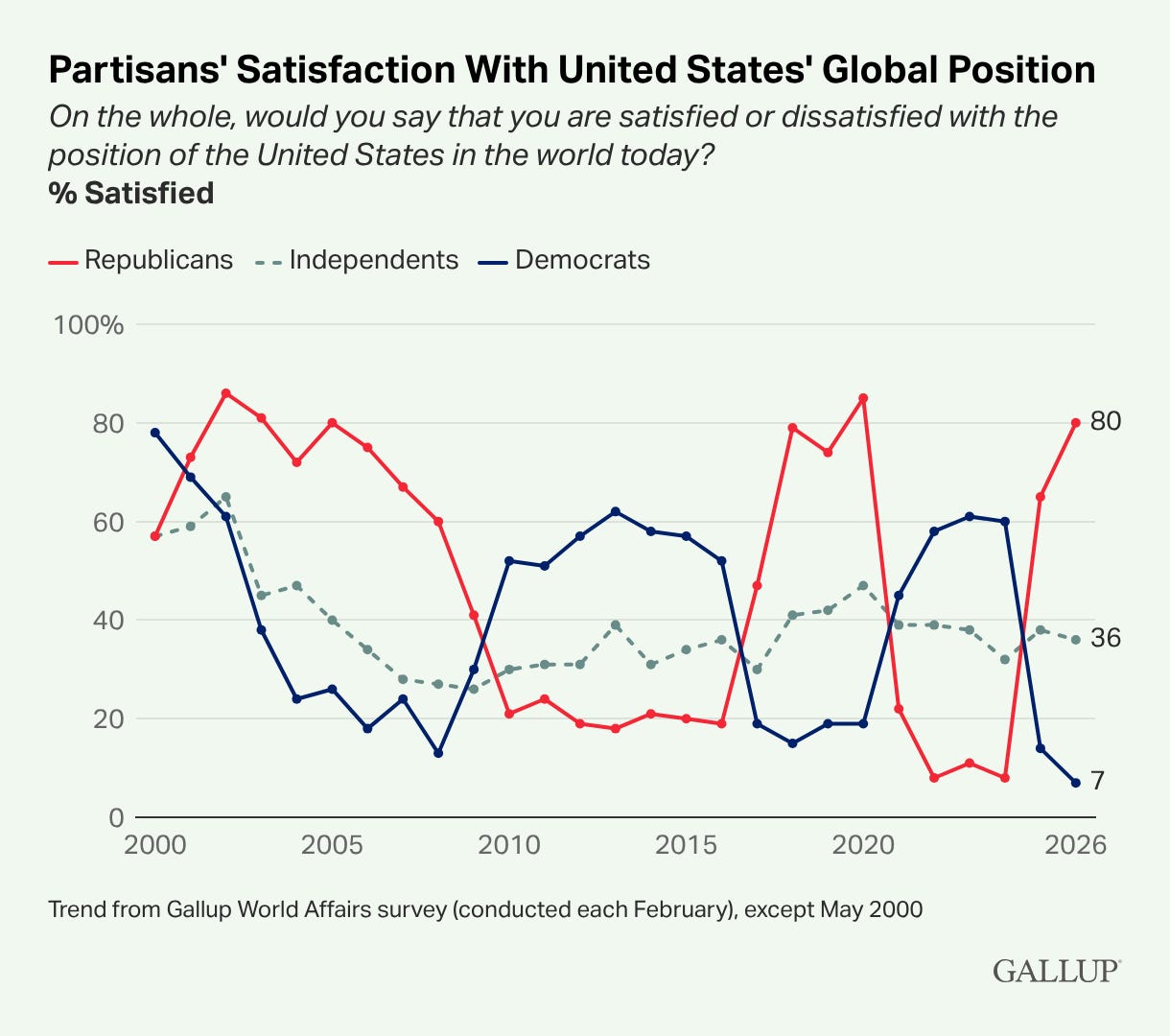
Gallup (3/5/2026) gives this graph the wrong section heading: Party Gap in Satisfaction With Country’s Position Is Record High. We are increasingly seeing extreme viewpoints from each party, depending on which party holds the presidency. This situation seems untenable to me.
Electricity
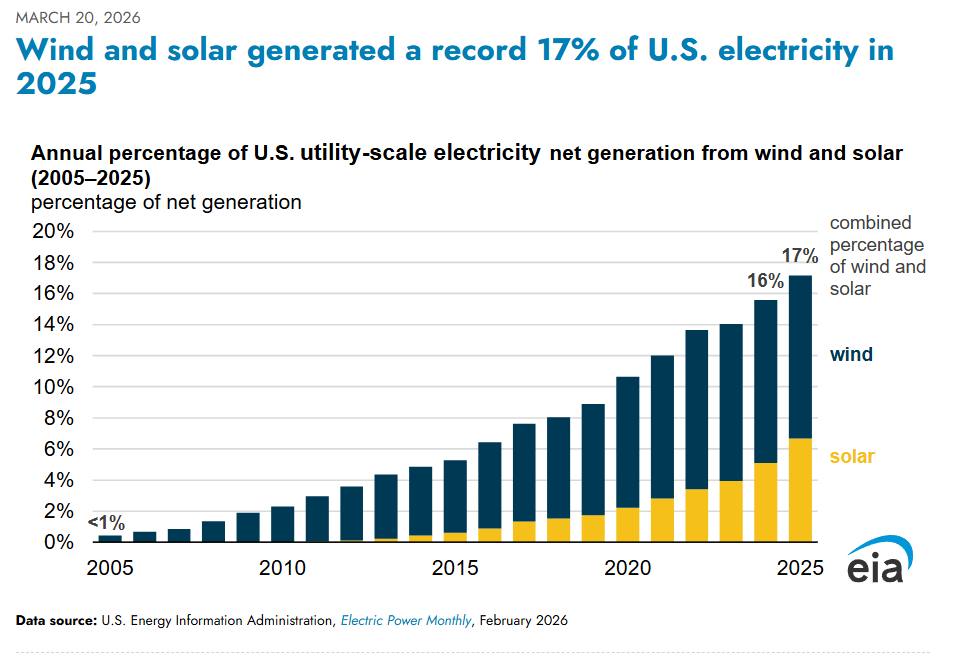
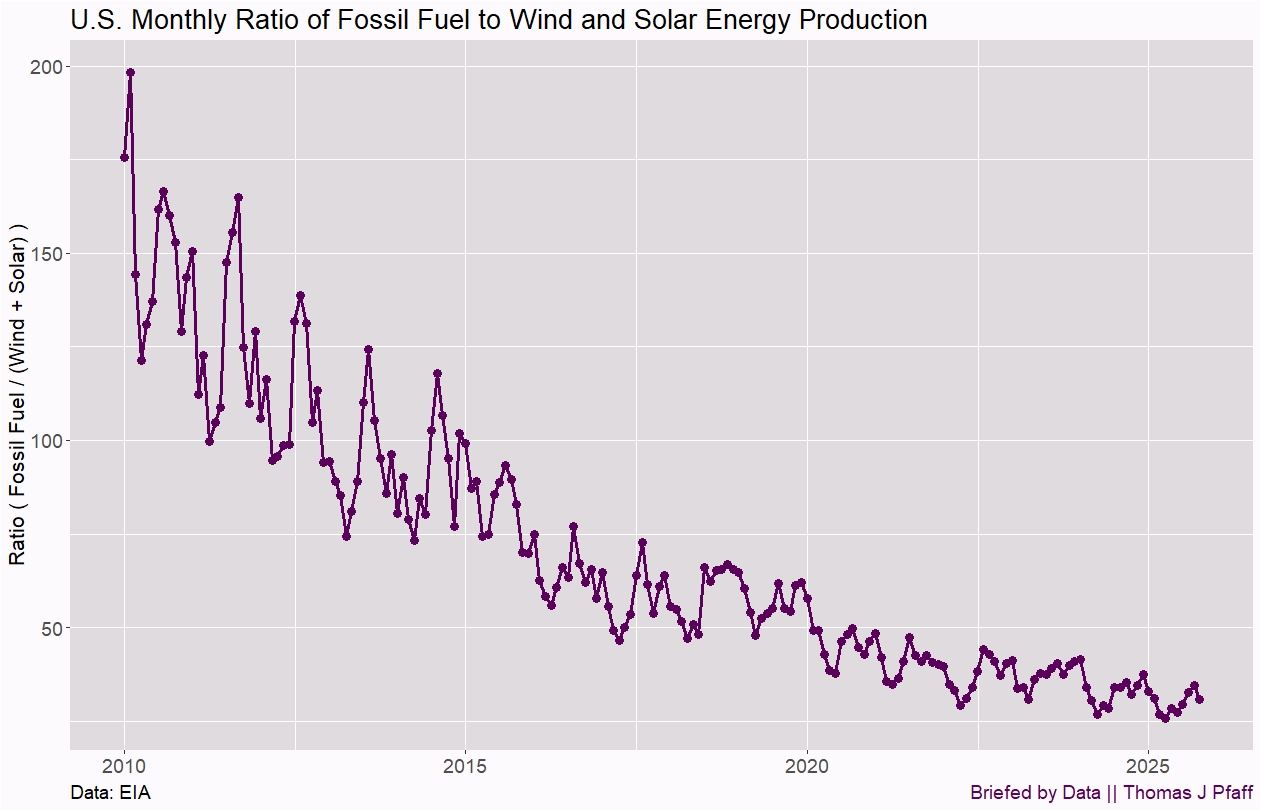
I wish the EIA would add some context to graphs like these. Adding solar and wind to the grid is a good thing in my view, as it diversifies the portfolio, ignoring issues of cost and grid stability of how we get electricity. While 17% looks good to some and will talk about greening the grid, let’s not forget that this figure is just for electricity. The second graph is from my post An Overview of U.S. Energy Production (2/17/2026) and shows that we use over 25 times more fossil fuel energy than wind and solar.
Pre- and post-pandemic alcohol use
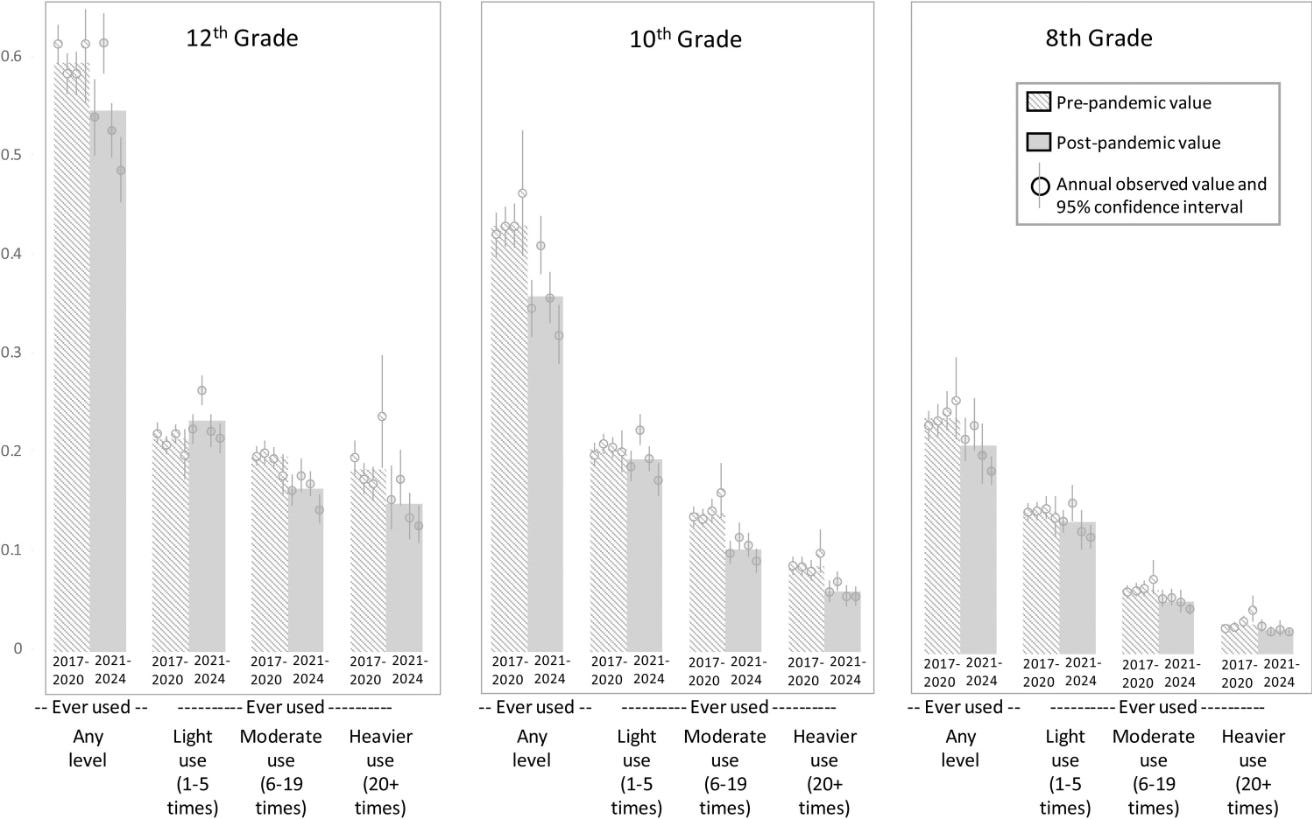
An interesting graph from the paper The Intensity of Adolescent Substance Use Before and After the COVID-19 Pandemic (4/2026).
After the pandemic onset, adolescent alcohol use softened notably, whereas cannabis use softened slightly. For alcohol, light use increased significantly across all 3 grades by 3–7 percentage points, moderate use decreased in all 3 grades by 2–4 points, and heavy use decreased by 4 points in 12th grade and 3 points in 10th grade. For cannabis, changes were limited to 10th grade, where light use increased by 3 points, and moderate use decreased by 2 points.
Some context from the introduction:
This study tests whether intensity of adolescent cannabis use and alcohol use hardened, softened, or did not change as prevalence levels for these substances fell after the pandemic onset in 2020. This study assesses intensity using lifetime prevalence, categorizing users into the groups of light, moderate, and heavier lifetime use. In the context of the hardening hypothesis—which originated in research on cigarette smoking—intensity refers to frequency and cumulative extent of use over time and not quantity of a substance consumed on a single occasion. Lifetime prevalence serves as a key metric to distinguish low-intensity users, who have used a substance only a few times, from high-intensity users, whose high levels of lifetime use can indicate more entrenched behavioral patterns and stronger identification with substance use.
Data center update
GDS Holdings hits $1.6 billion in revenue for 2025. Expects revenue to rise to $1.8 billion in 2026 (3/19/2026)
The spinning CD
Please share and like
Sharing and liking posts attracts new readers and boosts algorithm performance. I appreciate everything you do to support Briefed by Data.
Comments
Please let me know if you think I expressed something incorrectly or misinterpreted the data. I would rather know the truth and understand the world than simply be correct. I welcome comments and disagreement. I encourage you to share article ideas, feedback, or any other thoughts at briefedbydata@substack.com.
Bio
I am a tenured mathematics professor at Ithaca College, holding a PhD in math (stochastic processes), an MS in applied statistics, an MS in math, a BS in math, and a BS in exercise science. I consider myself an accidental academic (opinions are my own). I am a gardener, drummer, rower, runner, inline skater, 46er, and R user. I’ve written the textbooks “R for College Mathematics and Statistics” and “Applied Calculus with R.” I welcome any collaborations, and I’m open to job offers (a full vita is available on my faculty page).
"If we are going to try and send everyone to college, then we need to have programs that benefit the diversity of students."
Well-reasoned overall. Here is the pull quote.