

QTRS May 14, 2026
Graphs, commentary, and interesting content for the curious
As I see it. . .
With the spring semester just about wrapped up, I’m seeing the increasing influence of AI. Historically, there was a reasonable correlation between graded homework and in-class exams. Today, not so much. I have multiple examples of students with near-perfect homework grades and failing exam scores on exams with a median grade around 80%. For individual students this isn’t a surprise, as teachers have a good sense of students’ level of understanding based on classroom interactions. It is clear that in-class assessments, such as exams, are critical, and faculty are realizing their importance. For initial learning of material, exams do the trick.
But, as I see it, the problem lies with projects and longer assignments. Such an assignment might be a case study in a business course, an essay connecting all the reading in a history course, or a particularly long problem in a math course. I have for years done a project modeling future global temperatures in calculus (you can find it here). I won’t do this anymore, as too many students are using AI to complete the project.
The problem is that these types of projects in a class are a meaningful part of learning and making connections throughout the course, and they can all largely be done with AI. When students offload this work and learning to AI, they don’t learn anything. I’m not sure what we do because we really need to assume that anything done outside the classroom will be done by AI, and exams don’t cover everything we’d like students to get out of a course. We also need to give up on the idea that we can detect AI or at least detect it with a high enough probability to fail a student.
What do we do? I think we are at the point where the number of contact hours for a typical 3-credit course needs to increase with the addition of, say, a 3-hour “lab”-type meeting. This would provide a supervised setting for longer work, and the course instructor doesn’t need to supervise this “lab” time.
This would be a time where students work on the projects I mentioned above. We also know students aren’t reading, so maybe this is also a time when a student has to read 50-100 pages and write a short essay.
I do believe that the content knowledge, skills, and habits that students should get out of college are valuable, but right now it is clear some or many students aren’t gaining these skills as they offload learning to AI. It is a problem higher education needs to solve. Please let me know your thoughts in the comments.
Let’s go to some data before I head back to more grading.
On the SAT
This is a bit of old news, but you might not be aware that the SAT reading passages have shortened. (6/22/2025)
The College Board, creator of the SAT, notes in its Digital SAT Suite of Assessments that two main goals of its changes were to “make [the test] shorter and to give students more time per question.”
The “Reading and Writing” section of the test scaled back its 500-750-word reading passages to 25-150 words (“the length of a social-media post”) — with just one question per passage.
The rationale is that this “operates more efficiently when choices about what test content to deliver are made in small rather than larger units.”
This resulted in the elimination of significant portions of SAT’s previously used reading material, including “passages in the U.S. founding documents/Great Global Conversation subject area,” because of their “extended length.” Nevertheless, the College Board takes the view that the rigor of the Reading and Writing segment is unchanged. They claim in the assessment framework that the eliminated reading passages are “not an essential prerequisite for college” and that the new, shorter content helps “students who might have struggled to connect with the subject matter.”
The new SAT math section contains fewer questions, but allows the same amount of time for the assessment as before. Students also are permitted the use of calculators.
The College Board can say the short passages and single follow-up question are just as rigorous as the long passages with multiple questions, but I don’t buy it. This is a nod to students having shorter attention spans. On the other hand, maybe they are right in that reading long passages isn’t “an essential prerequisite for college,” which is a problem with college.
The last sentence, though, is just as much of an issue. I would argue that reading comprehension is just as important when reading something one struggles to connect with. Part of reading is learning things you don’t know, and part of college is introducing students to material even if they aren’t interested.
I continue to see higher education as slowly making itself irrelevant.
The kid’s trapped at home
It isn’t just that kids are spending too much time in front of screens and using AI for “learning”; as it seems, they aren’t allowed to leave the house. Here is a chart from the IFS article New IFS Brief: More Screen Time, Less Play Time For America’s Kids (5/5/2026) that I find concerning.
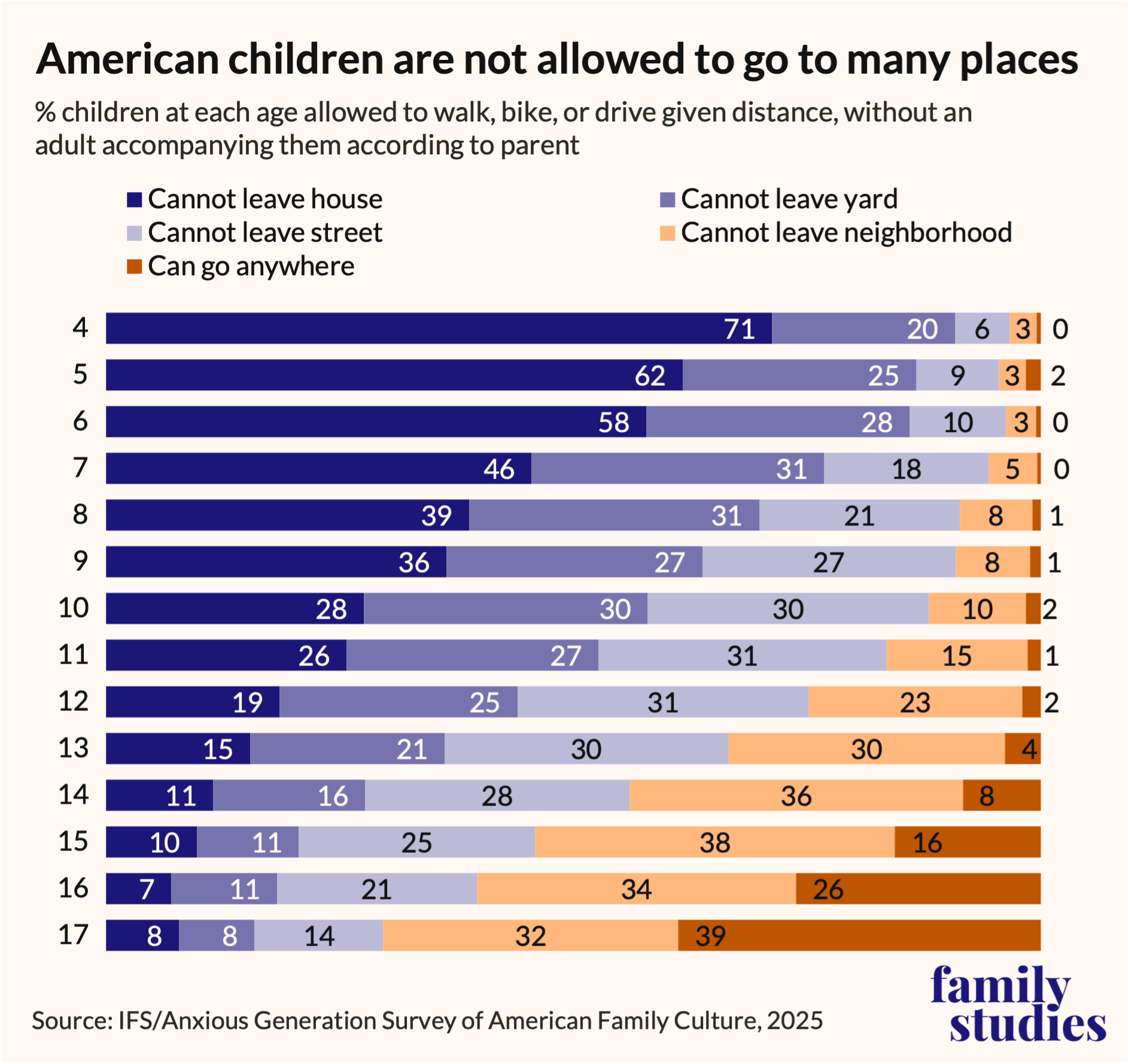
Only a quarter of 16-year-olds can leave the neighborhood. No wonder kids aren’t dating and hanging out with friends. They aren’t allowed to. 58% of 10-year-olds can’t even leave the yard. Except in certain circumstances, such restrictions seem vastly overprotective and is stunting the development of kids. Our kids had way more freedom than this.
On diversity
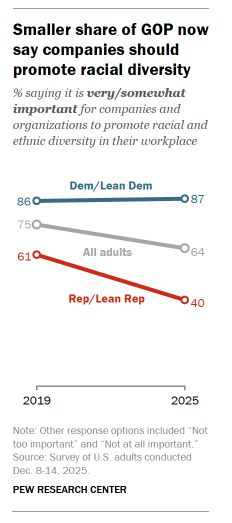
I think the left believes that the right is mostly racist and anti-diversity, but a recent Pew poll suggests otherwise. (3/25/2026) By and large, Republicans support diversity and say it is good. Yes, there is a small percentage that doesn’t, but that’s it.
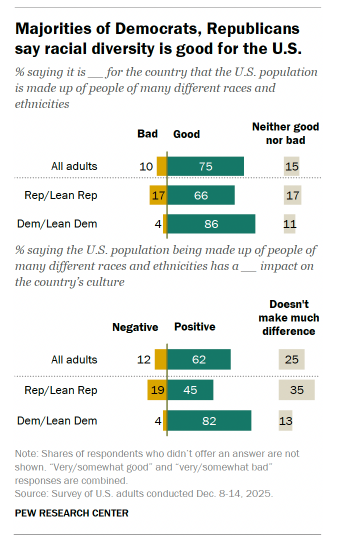
On the other hand, that doesn’t mean businesses need to support diversity initiatives, and this is where the two teams do disagree, but that isn’t the same as being racist or anti-diversity.
U.S. uses more fossil fuels
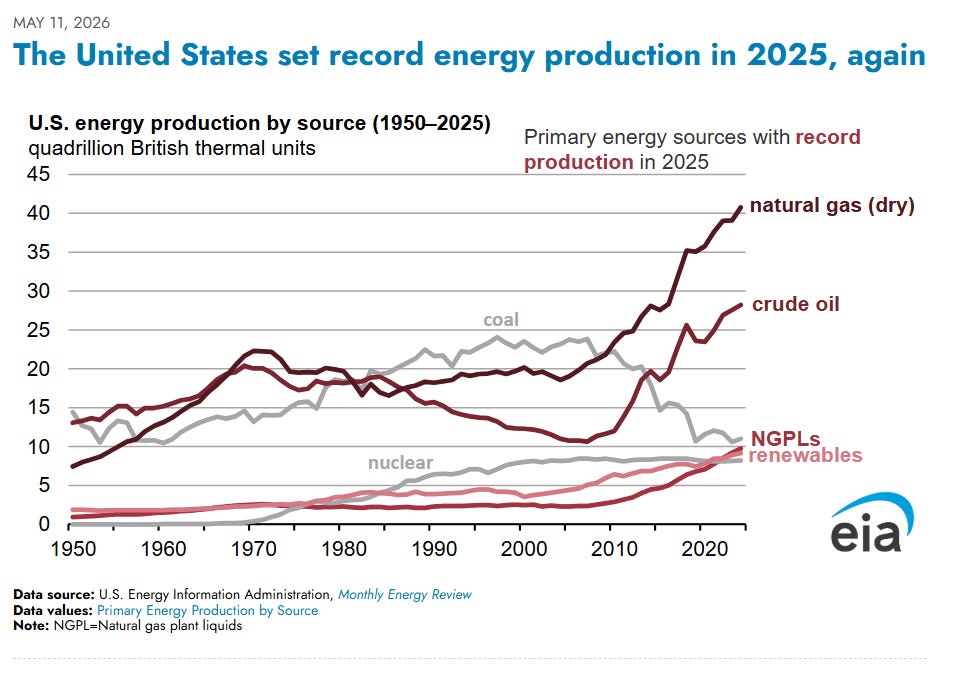
When we look at total energy use, not just electricity, fossil fuels still rule. From the EIA. We produce 4x as much natural gas (dry) as renewables and 3x as much oil. Another way to look at this is that in the last 10 years we increased natural gas (dry) production by more than renewables contribute today; similarly, for crude oil. I’m not anti-renewables; I’m pro-reality.
The spinning CD
Please share and like
Sharing and liking posts attracts new readers and boosts algorithm performance. I appreciate everything you do to support Briefed by Data.
Comments
Please let me know if you think I expressed something incorrectly or misinterpreted the data. I would rather know the truth and understand the world than simply be correct. I welcome comments and disagreement. I encourage you to share article ideas, feedback, or any other thoughts at briefedbydata@substack.com.
Bio
I am a tenured mathematics professor at Ithaca College, holding a PhD in math (stochastic processes), an MS in applied statistics, an MS in math, a BS in math, and a BS in exercise science. I consider myself an accidental academic (opinions are my own). I am a gardener, drummer, rower, runner, inline skater, 46er, and R user. I’ve written the textbooks “R for College Mathematics and Statistics” and “Applied Calculus with R.” I welcome any collaborations, and I’m open to job offers (a full vita is available on my faculty page).
Perhaps we are confronting, in an extremely indirect way, the reality that a university education is best utilized by individuals with intellectual capabilities well above the average of the population. The Educational Testing Service knew this at one time.