

QTRS May 21, 2026
Graphs, commentary, and interesting content for the curious
As I see it . . .
Historically, in my math classes, there was a decent correlation between graded homework and test grades. This pattern makes sense: the better you do on homework, the more you learn and the better you do on exams. This past year has changed that. The situation has changed this academic year. There is now a small group of students who have A and even perfect homework grades but are failing their exams. The reason is obvious, and in one case a student even admitted it.
These students are offloading their homework to AI and learning little to nothing in the process. I don’t even think they are doing this as a form of cheating. I think at least some of them see it as an effective use of AI and don’t connect it with failing exams.
As I see it, we need to quickly distinguish AI use into two categories. The first scenario is where AI functions effectively as an assistant. In the case, a human has knowledge and uses AI to be more efficient. Coding may be the easiest example. A proficient coder uses AI to draft code that they could write themselves, but AI does it faster. The code has to be fixed and edited. This person knows what they need to do and how to do it, but they may not learn much from doing the raw coding. Instead, they are using AI as an assistant to speed up the process.
The other case is where people are just functioning as a human interface with AI. In the case of my example above, students are simply an interface with AI. They don’t know how to do the homework problems and don’t understand the AI output or solution to the problem, and the point in doing them is to learn something. Maybe they get a little something out of copying the solution onto a piece of paper. In this case I might as well cut out the middle man, the student, and just tell AI to do the problem myself. This is the key problem here.
If your only role is as a human interface to AI, then it seems that “skill” could easily be replaced by a faster or better AI interface. Those rushing to incorporate AI into classrooms need to think carefully, because if all they are doing is training students to be an AI interface, they aren’t doing them any good. Humans learning information and gaining skills still matter.
Love to hear your thoughts on this in the comments.
Let’s go to some data.
Mental health
The Pew article Key findings about Americans and mental health (5/20/2026), but I’m not sure how to interpret it without some longitudinal data. For example, it has this chart:
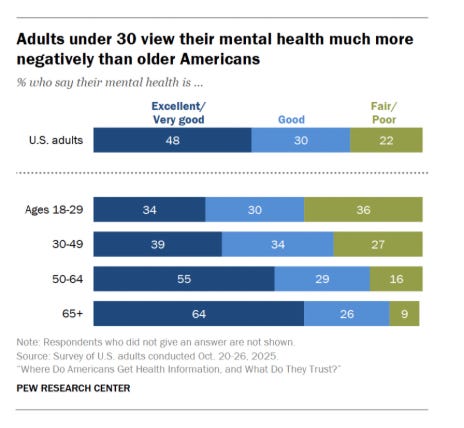
The mental health issues among 18- to 29-year-olds seem high. That is an issue itself, but has the situation changed over time? Maybe it is just the usual angst of teens and young adults. Now, I don’t think this is the case, but it shows how one should take one time data like this with a little skepticism. Data needs context to be meaningful.
Sea level change
The post a month ago by John, A Review of Sea Level Changes (4/21/2026), was popular, so I’d be remiss to not post this graph from the article Improved closure of the global mean sea level budget from observational advances since 1960 (5/21/2026).
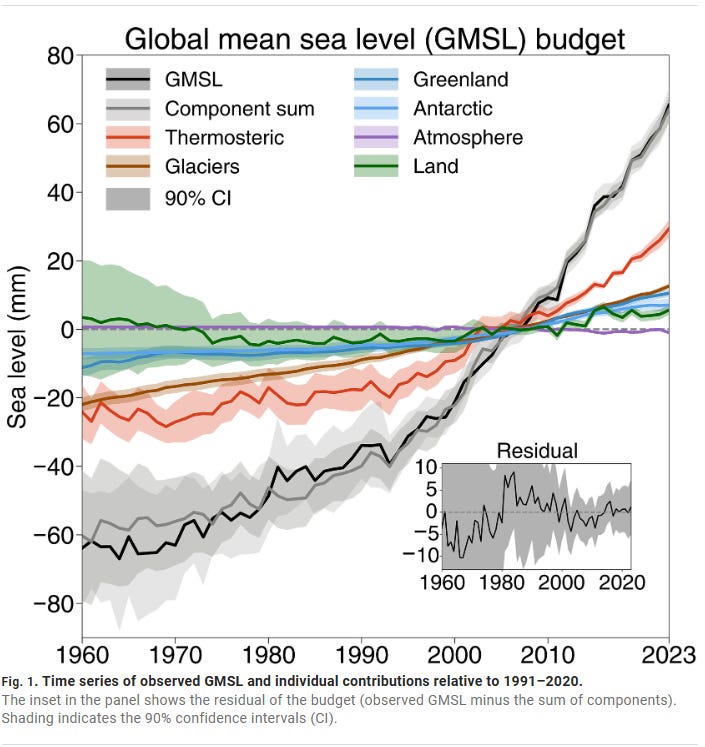
The principal drivers for the GMSL trend (acceleration) since 1960 are 43% (41%) from thermosteric ocean expansion, 27% (9%) from glacier melting, 15% (16%) from Greenland, 12% (13%) from Antarctic, and 3% (21%) from land water storage.
Science does know exactly what contributes to sea level rise.
Coal still has value
From the EIA:
In short, when the green is below the line, coal electricity is below the current market price. Note the green that dips well below during winter storm Fern. Electricity overall was expensive, and coal was cheaper by a lot. Wind and solar must not have been producing, and demand was high.
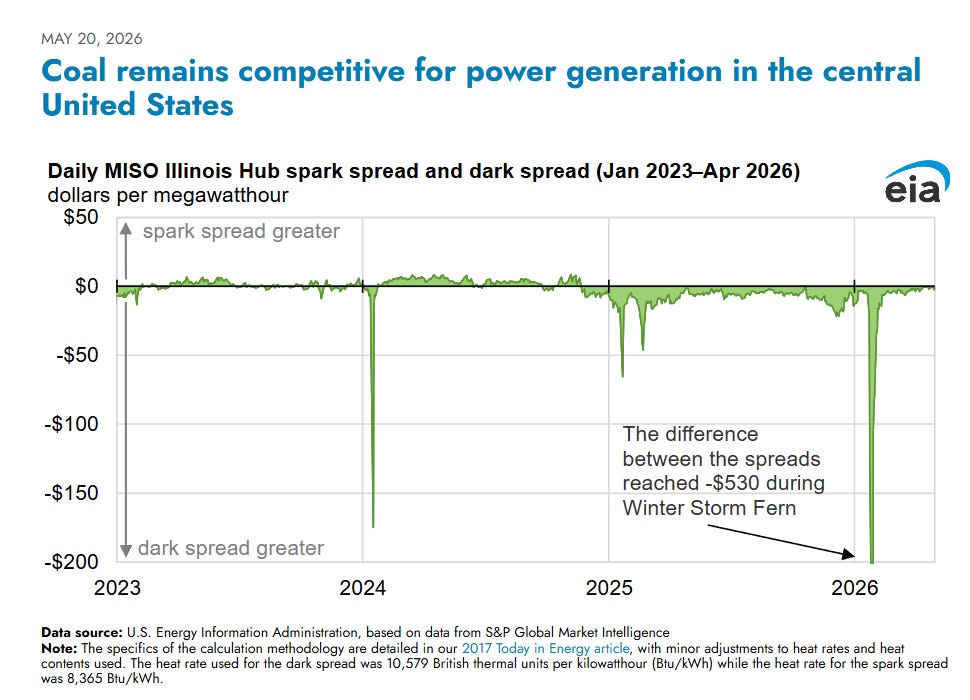
In the first four months of 2026, electricity, natural gas, and coal prices suggested continued favorable economics for coal generation in MISO. The dark spread of coal, the difference between the fuel costs for coal-fired generation and the wholesale electricity price, in the Midcontinent Independent System Operator (MISO) region outpaced a similar measure of revenue relative to fuel costs for natural gas-fired generators known as the spark spread.
The difference between the dark and spark spreads, both indicators of profitability, reached $530 per megawatthour (MWh) during Winter Storm Fern in January.
Beginning in late 2024, the dark spread in MISO began to be consistently larger than the spark spread. In 2025, the dark spread increased 111% compared with 2024 as the price for electricity increased faster than the cost to generate electricity from coal. The spark spread, however, increased at a slower rate, 18%, because rising costs for natural gas generation offset increasing electricity prices.
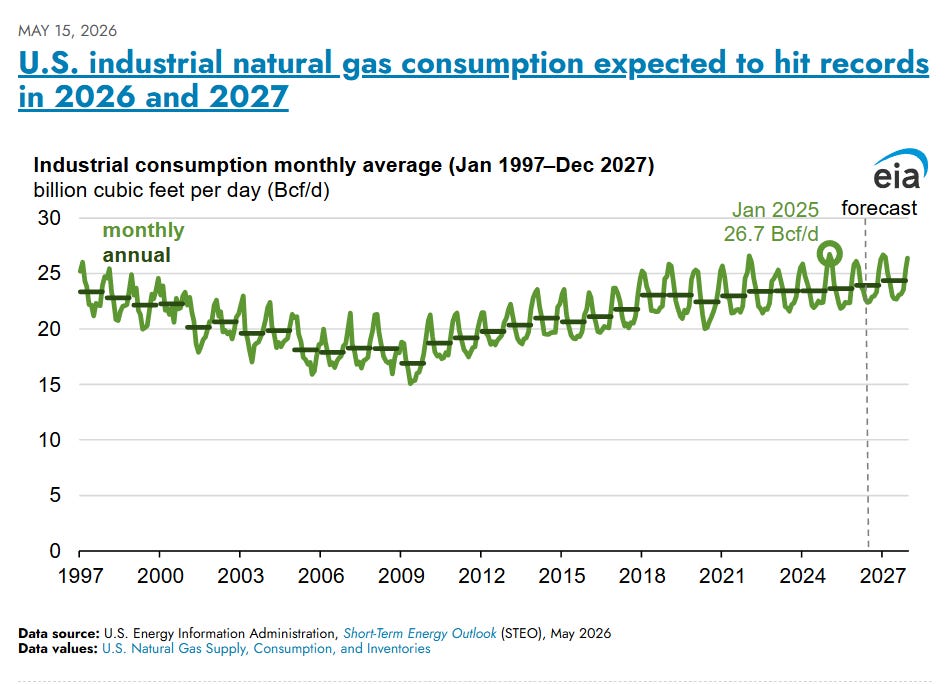
Natural gas doing fine too
Again from the EIA. All fossil fuels we can extract will get used.
The spinning CD
Please share and like
Sharing and liking posts attracts new readers and boosts algorithm performance. I appreciate everything you do to support Briefed by Data.
Comments
Please let me know if you think I expressed something incorrectly or misinterpreted the data. I would rather know the truth and understand the world than simply be correct. I welcome comments and disagreement. I encourage you to share article ideas, feedback, or any other thoughts at briefedbydata@substack.com.
Bio
I am a tenured mathematics professor at Ithaca College, holding a PhD in math (stochastic processes), an MS in applied statistics, an MS in math, a BS in math, and a BS in exercise science. I consider myself an accidental academic (opinions are my own). I am a gardener, drummer, rower, runner, inline skater, 46er, and R user. I’ve written the textbooks “R for College Mathematics and Statistics” and “Applied Calculus with R.” I welcome any collaborations, and I’m open to job offers (a full vita is available on my faculty page).
I am so glad much of my original research is based on observations made outdoors watching birds. AI could fake it but could not substitute for the original field observations nor for other activities that are based on acquiring unique data points. Which tree species does the bird nest in? AI might predict probability after enough original field observations were obtained. It could not predict which tree was used in the absence of the original data. How many eggs were laid, how many young hatched, or how many fledged for a particular year. Determination of the observations that comprise a mean is totally different from using the mean to predict an event. I'm so glad AI will not replace my good old-fashioned search for the nesting bird.
John
Teachers could be promoting and modeling the use of ChatGPT's study mode.
Of course the labs themselves need to invest much more in products and features to help young people reach their potential if they want to retain their social license to operate. Based on recent opinion surveys and reports of activism that I have seen, they are in real danger of losing that. It turns out that telling people "our product is either going to take all the jobs, or kill you all, or both" was not a good marketing strategy.