

QTRS May 7, 2026
Graphs, commentary, and interesting content for the curious
As I see it . . .
Consider this paragraph from the Washington Post article Students are speeding through their online degrees in weeks, alarming educators (4/19/2026):
The North Carolina human resources executive spent two months racking up credits through web tutorials after work in 2024, then raced through 11 online classes at the University of Maine at Presque Isle in four weeks. Later that year, she went back to earn her master’s — in just five weeks. The two degrees cost a total of just over $4,000.
11 classes in four weeks? Presumably they are three credit classes, in which case that is traditionally two semesters of college. I don’t see how the human brain can absorb similar information and gain similar skills in four weeks as compared to two 14-week semesters.
As I see it, this is another example of higher education losing the plot. In the chase for revenue to stay in business, they continue to devalue their product, and this is the beginning of their confusion because their product is the student, not the piece of paper. I’m convinced that higher education thinks having a degree is what’s important and how it is achieved doesn’t matter. AI did all your work, no problem. Lower expectations to maintain retention; no problem. Online courses, with no idea who did the work, are completed in record time, no problem. We’ve known for decades that summer or winter courses, done in 6 weeks or 8 weeks and meeting for hours each day, weren’t and aren’t equivalent to semester courses; again, no problem. Grade inflation, where everyone is above average, no problem.
As an aside, it infuriates me when I hear stories of faculty members making it effortless for students to cheat. Paying no attention during exams while students use their phones or giving take-home exams is a problem. I don’t want to police cheating, but I don’t have a choice, and not doing so is a form of putting myself out of business. Again, I’m lowering the value of the product; the only thing the student learned, if anything, was how to look up answers on a phone.
While the focus on helping students complete degrees through lower expectations, retention efforts, online courses, etc. and on lowering costs is admirable, employers still value degrees, though less so; if the product continues to deteriorate, the degree will eventually become worthless. In other words, the student doesn’t know more or have better skills from getting the degree.
By all means, let’s experiment with online degrees and any other idea, but we need to clearly label what was achieved and let the market decide. Now, if the market decides that the four-week degree is just as good as the four-year degree, then maybe there is something wrong with the four-year degree. Let me know your thoughts in the comments.
More on education
Two good articles from the Hechinger Report. The first quote is this from AI gives more praise, less criticism to Black students (4/27/2026)
attributed to Black students received more praise and encouragement, sometimes emphasizing leadership or power. (“Your personal story is powerful! Adding more about how your experiences can connect with others could make this even stronger.”) Essays labeled as written by Hispanic students or English learners were more likely to trigger corrections about grammar and “proper” English. When the student was identified as white, the feedback more often focused on argument structure, evidence and clarity — the kinds of comments that can push writers to strengthen their ideas.
The AI models addressed female students more affectionately and used more first-person pronouns. (“I love your confidence in expressing your opinion!”) Students labeled as unmotivated were met with upbeat encouragement. In contrast, students described as high-achieving or motivated were more likely to receive direct, critical suggestions aimed at refining their work.
Apparently AI has biases. AI learns from the internet, and so it will pick up biases from what it “reads.” I know faculty are starting to use AI to provide comments and at least partially grade student work, and I doubt they would pick up this bias. We really need to put some breaks on the use of AI in education.
The second quote is from their article Kids and parents dislike math homework, so teachers are scrapping it. Will students be better off? (4/27/2026)
A few days into the new semester this January, the LaSalle Parish school district in rural Louisiana made a pronouncement: There would be no more homework.
None of the 2,500 students in this district — from the youngest learners up through high school seniors — are required to do schoolwork at home this semester. Parents can request practice problems if they’d like, Superintendent Jonathan Garrett said, but that work won’t be mandatory or graded.
Homework assignments, it turned out, were among the biggest sources of complaints Garrett had heard from parents and students over the years.
and
Indeed, federal survey data suggests that the amount of math homework assigned to fourth and eighth grade students, in particular, has been steadily declining for the past decade.
On one hand, there are equity issues with homework. It is more likely to get done in a household with supportive parents. At the same time, the school day is broken up into lots of small chunks. Our local high school has classes that are 47-49 minutes long, while middle school classes are under 40 minutes long. That’s not a lot of time to wrangle kids, get them focused, and make progress.
Now if the school day were longer, I might be ok with less emphasis on homework. But, for many subjects, there needs to be some focused, independent quiet time to learn materials. I don’t think it is unreasonable for, say, an elementary student to practice some multiplication tables at home for 5 minutes and a high school student to spend time doing some math problem sets.
The worst part here, though, is this: “Parents can request practice problems if they’d like.” This policy just creates greater inequality. Educated and motived parents will ask for the practice problems. Others will just assume the practice isn’t necessary and their kids will fall farther behind from the others without even realizing they weren’t doing something right.
I don’t get it. Getting information into long-term memory requires consistent retrieval practice, more or less depending on the person. It has to happen somewhere. Maybe we need to figure out where that is supposed to happen. If there isn’t time at school, then it has to be done at home.
Men living at home
The article Higher rents keep men at home (4/8/2026) at AIBM has some interesting results from their analysis. Here are the highlights
Using census data, I study the causal impacts of higher housing costs in my paper “Housing Costs, Parental Resources, and Declining Male Labor Force Participation.” I find that:
A 10% increase in local rents increases the likelihood that non-college men live with their parents by about 1.1 percentage points.
The same rent increase is associated with a 0.5 percentage point decline in labor force participation.
Initial estimates suggest that higher housing costs could explain a third of the employment decline among non-college men.
Men living with their parents are 20 percentage points less likely to be in the labor force than those living independently.
About 1 in 6 men without a college degree are living with their parents (16%), compared to 8% of men with a college degree.
Men are much more likely than women to be living with parents (12% vs. 7%).
These findings have policy implications. By raising the price of independence, policies that restrict housing supply and raise housing costs may be an underappreciated driver of male labor force decline. Rahm Emanuel, the former Mayor of Chicago and likely presidential candidate, wrote recently that male despondency and rising housing costs are “two sides of the same coin.” My results suggest he may be onto something.
With that noted, this set of graphs got my attention.
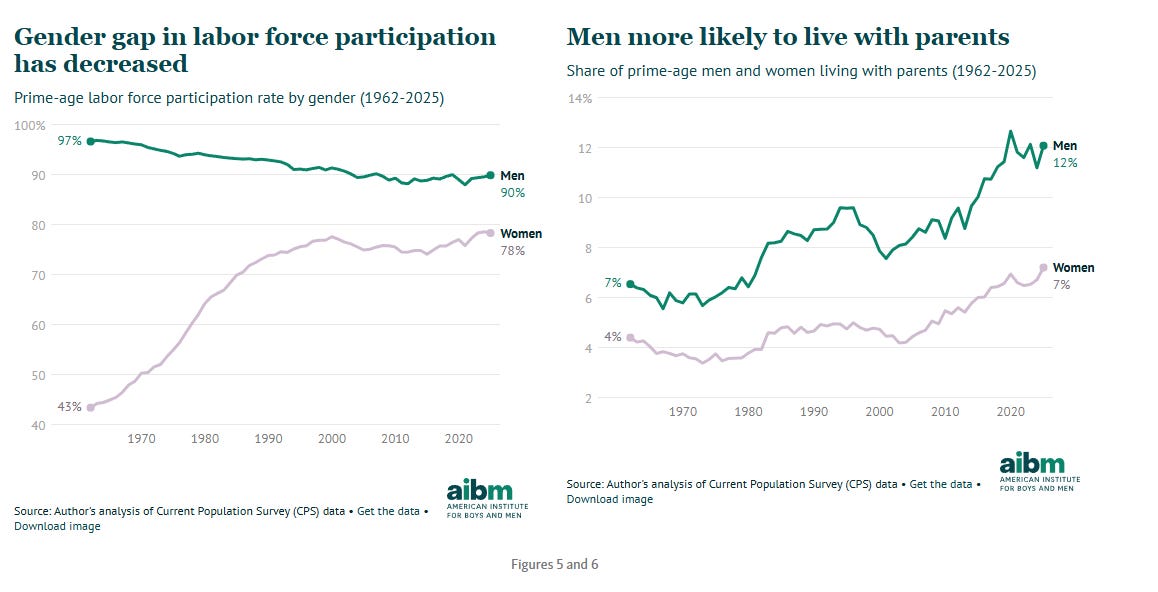
If women have always participated at a lower rate in the labor force than men, how is it that they are also less likely to live at home? It would seem that the answer is that one option for women is to marry a man who can provide a place to live and then not work. This is an option that men generally do not have, and it would provide one explanation for why the job market and housing costs impact them more significantly.
Data center report
AWS operated 56.84 million square feet of data center and office space in 2025 (5/5/2026).
I found that number staggering and needed a reference. Gemini tells me that is equivalent to about 10 Mall of Americas.
The spinning CD
Please share and like
Sharing and liking posts attracts new readers and boosts algorithm performance. I appreciate everything you do to support Briefed by Data.
Comments
Please let me know if you think I expressed something incorrectly or misinterpreted the data. I would rather know the truth and understand the world than simply be correct. I welcome comments and disagreement. I encourage you to share article ideas, feedback, or any other thoughts at briefedbydata@substack.com.
Bio
I am a tenured mathematics professor at Ithaca College, holding a PhD in math (stochastic processes), an MS in applied statistics, an MS in math, a BS in math, and a BS in exercise science. I consider myself an accidental academic (opinions are my own). I am a gardener, drummer, rower, runner, inline skater, 46er, and R user. I’ve written the textbooks “R for College Mathematics and Statistics” and “Applied Calculus with R.” I welcome any collaborations, and I’m open to job offers (a full vita is available on my faculty page).